
The Man Who Taught the World About Bubbles Was Born in the Prosecco Hills
Venanzio Fortunato Valdobbiadene – The Hidden Link Between Prosecco and Champagne
A saint born in Valdobbiadene in 530 AD became Bishop of Poitiers. Dom Pérignon visited his abbey. Could the origin of sparkling wine trace back to the Prosecco hills? The story no one tells.
Some connections are hidden in plain sight. You only need to know where to look.
This is a story that begins in the hills between Conegliano and Valdobbiadene — the same hills that today carry a UNESCO World Heritage designation, the same hills where vines have grown for two thousand years. It ends, improbably, in the cellars of Champagne. And in the middle stands a poet, a bishop, and a monk who changed the history of wine.
A child of Valdobbiadene.
In the year 530 AD, in the Roman settlement of Duplavilis — the place we now call Valdobbiadene — a boy was born who would become one of the most celebrated poets of the early Middle Ages, a bishop, and eventually a saint of the Catholic Church.
His name was Venanzio Fortunato.
He grew up in these hills, in a landscape already ancient with viticulture, already shaped by the hands of farmers who understood that this particular combination of slope and soil and sky produced something extraordinary. He left as a young man to study in Ravenna, and then — following a vow of gratitude to Saint Martin — he began a long journey westward through the Frankish kingdoms, writing poetry in exchange for hospitality at the courts of kings and bishops.
He never came back. But what he carried with him — the memory of these hills, the culture of wine that had surrounded him since childhood — travelled with him all the way to France.
The bishop of Poitiers.
Venanzio Fortunato eventually settled in Poitiers, in western France, where he found friendship and protection with Saint Radegonde, a queen who had abandoned her throne to found a monastery. He became her poet, her companion, her spiritual brother. And around 597 AD, he was appointed Bishop of Poitiers — one of the most important ecclesiastical positions in Frankish Gaul.
He died in Poitiers in 607 AD, and was venerated as a saint almost immediately after his death. His feast day is still celebrated in the diocese of Padova — the diocese to which Valdobbiadene belongs.
A boy from Valdobbiadene, buried in France. A saint of two worlds.
The monk who came to learn.
Nearly a century later, in 1668, a young Benedictine monk named Pierre Pérignon — Dom Pérignon — was appointed cellarmaster of the Abbey of Hautvillers in the Champagne region of France.
The story of what happened next has been told many ways. But one version — persistent, compelling, and historically grounded — tells of a pilgrimage Dom Pérignon made to the ancient Benedictine Abbey of Saint-Hilaire in Poitiers. The same city where Venanzio Fortunato had been bishop. The same city where the tradition of wine knowledge, carried from the vineyards of the Frankish world, had been preserved for centuries in monastery cellars.
It was there, the story goes, that Dom Pérignon encountered a method of winemaking that produced bubbles — a technique of secondary fermentation that the monks of Poitiers had been quietly practicing. He brought it back to Hautvillers. He refined it, perfected it, and gave it to the world.
The thread that connects everything.
We cannot say with absolute certainty that the wine knowledge preserved in Poitiers traced directly back to Venanzio Fortunato. History rarely offers that kind of precision.
But consider this: a boy born in Valdobbiadene in 530 AD grows up surrounded by a viticulture already ancient — Roman roads, Roman vines, the deep knowledge of a landscape that has been producing wine for centuries. He travels to France. He becomes a bishop in Poitiers. He lives there for decades, in the heart of a monastic culture where wine is not just a drink but a sacrament, a science, a tradition passed carefully from generation to generation.
Centuries later, a monk visits Poitiers and discovers something extraordinary in its abbey cellars. He brings it home and changes the history of sparkling wine forever.
These hills did not just produce Prosecco. They may have given the world its bubbles.
A saint who never forgot where he came from.
Today, in Valdobbiadene, Venanzio Fortunato is remembered — in the name of a local wine producer, in the feast days still celebrated in his honour, in the quiet pride of a town that knows one of its own changed the world.
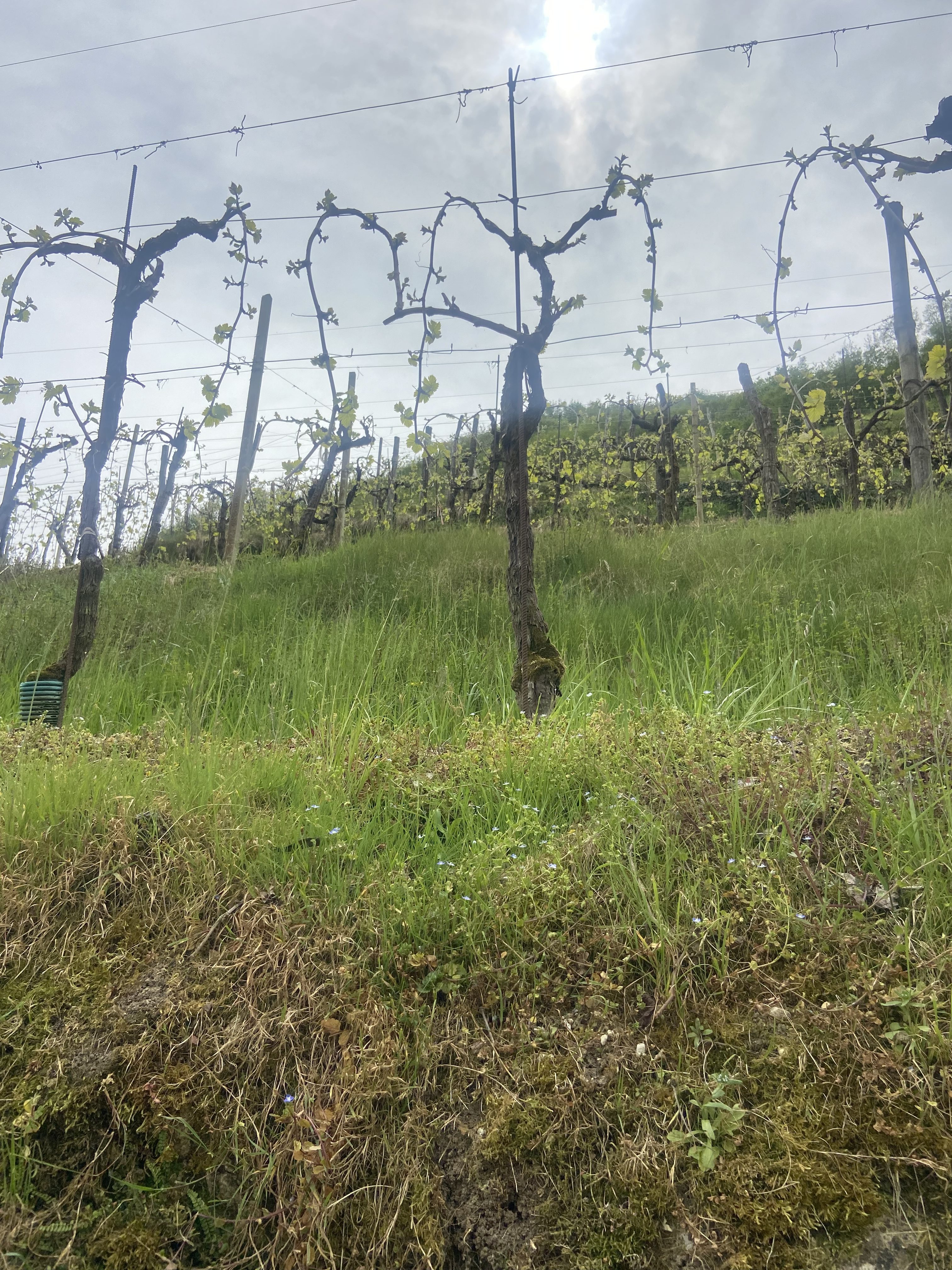
When you stand on these hills and look out over the rows of vines descending into the valley — the same landscape that a six-year-old boy named Venanzio looked out over fifteen centuries ago — you are standing inside a history that goes far deeper than any guidebook will tell you.
Pick up a glass of Prosecco Superiore.
The bubbles started here.
Alcune connessioni sono nascoste in piena vista. Basta sapere dove guardare.
Questa è una storia che comincia nelle colline tra Conegliano e Valdobbiadene — le stesse colline che oggi portano il riconoscimento UNESCO, le stesse colline dove le viti crescono da duemila anni. Finisce, improbabilmente, nelle cantine della Champagne. E nel mezzo si trova un poeta, un vescovo e un monaco che hanno cambiato la storia del vino.
Un figlio di Valdobbiadene.
www.orianancc.it Prosecco Hills Wine tour near Venice