
The Living Landscape: Glera, Ancient Varieties and the Biodiversity of the Prosecco Hills
Glera Grape and Biodiversity – The Living Landscape of Conegliano Valdobbiadene UNESCO Hills
65% forest, ancient chestnut trees, wild herbs, cherry and peach trees among the vines. And five forgotten grape varieties still alive. The extraordinary biodiversity of the Prosecco UNESCO hills.
Close your eyes and imagine a vineyard.
You are probably imagining rows of vines, perfectly aligned, stretching to the horizon under an open sky. A monoculture. A factory of grapes.
Now open your eyes and look at the Conegliano Valdobbiadene UNESCO hills.
This is something else entirely.
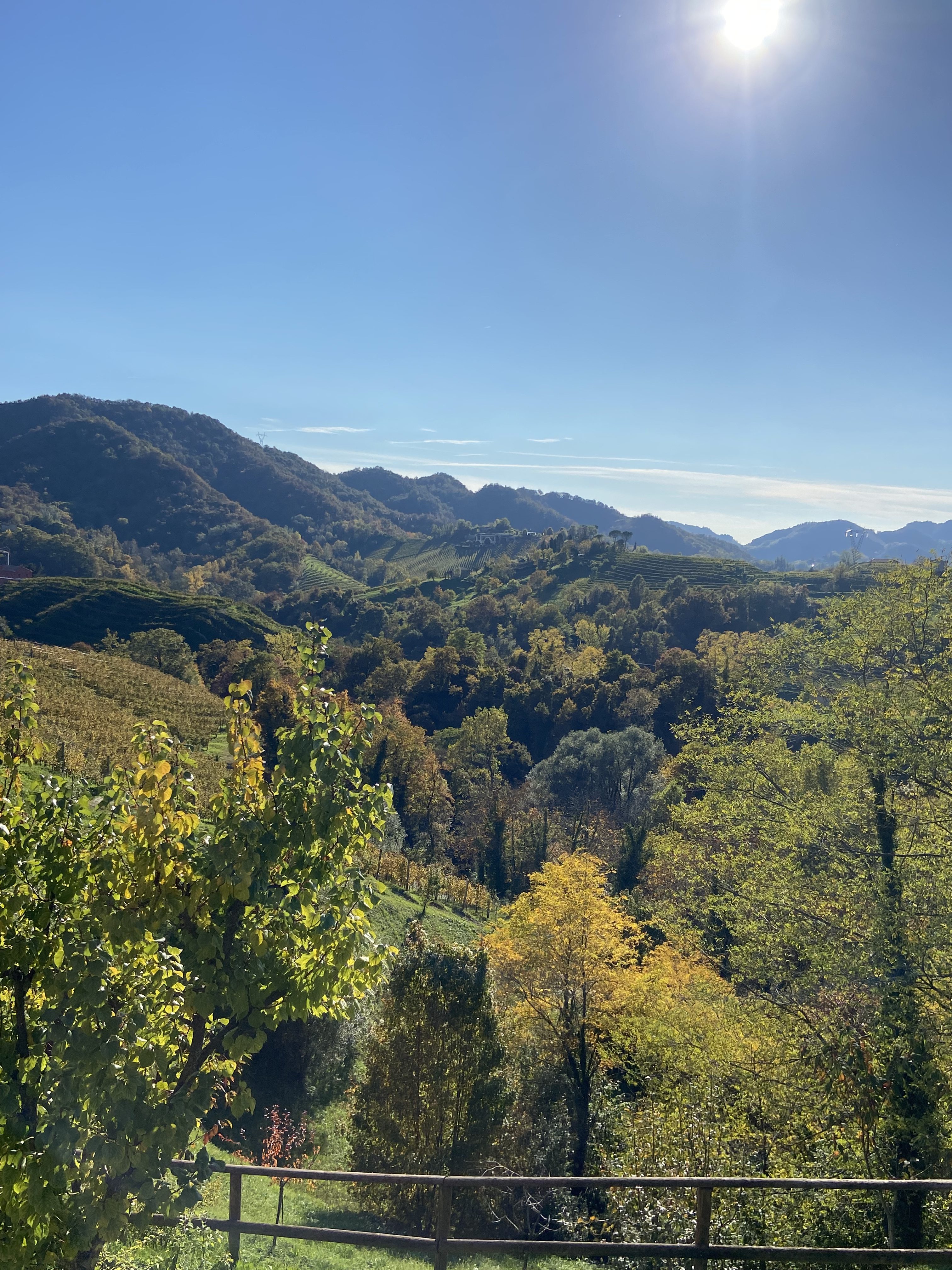
he hills between Conegliano and Valdobbiadene are not a vineyard. They are a landscape — complex, layered, alive — where vines occupy only 35% of the territory. The remaining 65% is forest.
65% forest.
The hills between Conegliano and Valdobbiadene are not a vineyard. They are a landscape — complex, layered, alive — where vines occupy only 35% of the territory. The remaining 65% is forest.
Ancient chestnut trees line the boundaries between woodland and vine, their roots deep in the same soil that feeds the Glera. For centuries, these chestnuts fed the families of these hills in the difficult seasons — when the harvest was poor, when the winter was long, when the wine alone was not enough. They are still here, still standing at the edge of the vineyards, witnesses to everything these hills have lived through.
Between the rows of vines grow cherry trees, pear trees, peach trees — planted by the same hands that planted the vines, by families who understood that a living landscape is a resilient landscape. Their blossoms perfume the air in spring. Their fruit ripens alongside the grapes in summer.
And everywhere — in every corner, along every path, at the foot of every vine — an incredible variety of wild herbs. Thyme, sage, mint, chamomile, and dozens of species that have no name in any guidebook. They feed the soil. They attract the pollinators. They breathe into the air that the vines breathe.
This is not a vineyard. It is an ecosystem. And it is UNESCO for a reason.
Glera — the soul of these hills.
At the heart of this landscape grows the Glera — the ancient autochthonous grape variety that has been cultivated in these hills for centuries. Not imported, not selected in a laboratory, not optimised for yield. Evolved here, in this specific combination of limestone and clay, of morning mist and afternoon sun, of forest air descending from the chestnut woods in the evening.
Glera is not a simple grape. It is generous and aromatic, with a natural acidity that keeps the wine fresh and alive. In the right hands — on these specific slopes, in this specific microclimate — it produces a wine of floral delicacy and mineral depth that no other territory can replicate.
But Glera is not alone. It never was.
The forgotten varieties.
Before Glera became the protagonist of these hills, the vineyards were more diverse — a mosaic of varieties, each with its own character, its own role, its own story.
Five ancient varieties have survived. Not in museums. Not in experimental vineyards. Here, in the working vineyards of the Conegliano Valdobbiadene hills, still growing, still producing, still alive. Together, they can be blended with Glera in the Prosecco Superiore DOCG — up to 15% in total — adding complexity, depth and the memory of a more diverse viticulture.
Bianchetta Trevigiana — delicate, light, with a freshness that speaks of high altitude and cool nights. A grape that the families of these hills have always known, that appears in documents going back centuries, that almost disappeared and didn't.
Perera — named for the pear tree, pero in Italian — and indeed its aromas recall exactly that: ripe pear, white flowers, a gentleness that makes it immediately recognisable. Rare, precious, still here.
Verdiso — the most structured of the five, with a marked acidity and a mineral character that speaks directly of the limestone soil beneath these slopes. Once widely grown across the Treviso foothills, now found almost exclusively in these UNESCO hills.
Prosecco Lungo and Prosecco Tondo — two ancient biotypes of the same family, distinguished by the shape of their grape cluster. Lungo — long. Tondo — round. Simple names given by farmers who described exactly what they saw. Both predate the modern Glera, both carry the memory of a viticulture older than any denomination, and both are still found in the oldest vineyards of these UNESCO hills.
These five varieties are not curiosities. They are living history — preserved by the families who never saw any reason to abandon them.
A landscape you can taste.
Walk these hills in May and the air is extraordinary — the scent of chestnut blossom mixing with wild herbs and the first green shoots of the vine. In September, as harvest approaches, the perfume of ripe fruit fills every corner of the landscape — peaches warming in the sun, pears beginning to fall, grapes reaching their final concentration.
This is the air that the Glera breathes. This is the soil that the ancient varieties draw their minerals from. This is the ecosystem that makes a glass of Prosecco Superiore DOCG taste the way it does — not just of grape, but of place. Of forest and fruit and herb and stone and the particular quality of light on a south-facing slope in the hills between Conegliano and Valdobbiadene.
Terroir is not a word. It is everything you have just read.
When you walk these hills with me, you will see this landscape with new eyes. The chestnut trees at the edge of the vineyard. The wild herbs underfoot. The old vines of Bianchetta, Perera, Verdiso, Prosecco Lungo and Prosecco Tondo still growing between the rows of Glera, tended by families who have never stopped believing in the value of diversity.
You will understand, perhaps for the first time, that the wine in your glass is not just the product of a grape. It is the product of an entire living world.
Book your private tour at orianancc.iProsecco Hills Wine tour near Venice